
Text
Mehran MohajerVeiled and Drunk
The photograph is a small fragment of the photographer’s extended,
multi-year memories, shortened to a One and a half meter memories. They are
condensed to the length of a 35mm film, and the negative of this photograph is
about four centimeters of that one-and-a-half meters. So it seems we have the
right not to see some parts of these memories or to try to imagine them in our
mind. Speaking of the photograph’s negative, which according to Jeffrey Batchen
is the “other” of the photograph — or the absent half. It is the instant we do
not see. Here too, the photograph itself seems to be that “other” of the
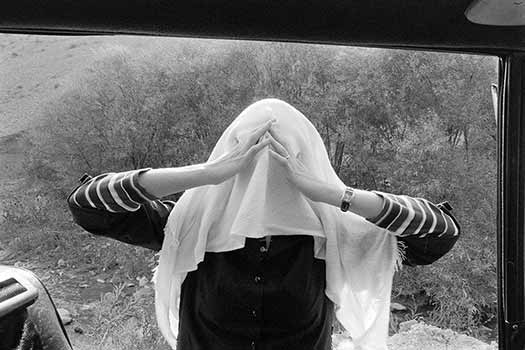
memories. The absent part of the memories. The car frame seems to point to the
film frame, and the photographer shows a view from the half-frame of the car
that we don’t know where it is. In front of this view stands a woman who has
veiled her face — neither seeing us nor the view — and we see neither her nor
the view. And in this accumulation of not seeing, can imagination be brought to
the workshop of seeing? The veiled (or hidden) has a state that we don’t know
what kind of state it is.
But whatever it is, the photograph, as years pass, seems to speak about our
current state.