
Text
Pouya KarimBehind the Mirror
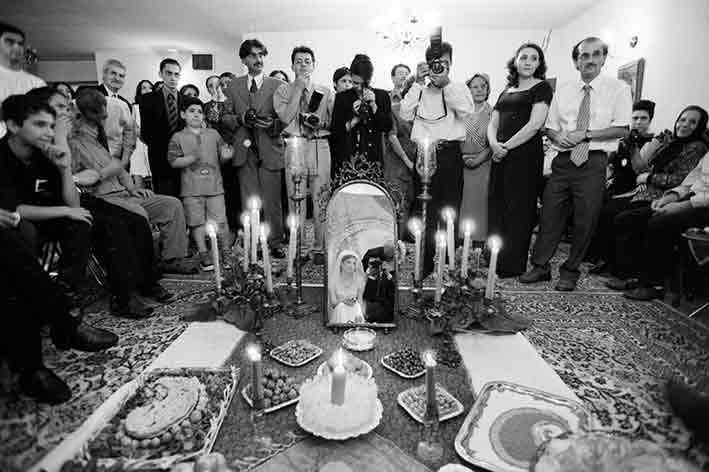
At the moment of taking a family picture no one is truly
prepared and it seems everyone is preoccupied with the celebration of life. No
one’s look seeks a memento for themselves, and contrary to the usual custom of
commemorative photographs, the camera’s eye goes unanswered. But among the absent
looks in the frame and behind the mirror frame of connection the
fixed and solitary gaze of a man appears as an exception and a rupture. A
rupture between self and other, presence and absence, connection and
separation, death and life.
Everything begins from the middle, and the mirror here serves as a
self-portrait, a light-bearing image and symbol. But what is the subject of
this self-portrait, and where is it? The subject of the self-portrait is both
the photographer’s body—whose face and identity here are concealed by the
camera—and the woman, with her hands clasped and a white veil over her face,
dressed as a bride, sitting shoulder to shoulder with the photographer in front
of a patterned curtain, both seemingly staring beyond the four corners of the
image. The image of the mirror, moving between glances and signs, becomes a
theatrical scene with two subjects each playing their own role. On another
level, the subject of the self-portrait, through the presence of the
photographer, the bride, and the familiar patterned curtain, represents the act
of “photography.” The mirror, like the framed photograph, on one hand links the
photographer’s body to the lived experience within the overall frame of the image
and on the other hand connects to the artistic experience within the mirror’s
frame. Thus, it spontaneously expresses an intuitive insight: art is not so
separate from life; life is precious, but art is the pleasant form of life. Therefore,
the logic of this self-portrait complicates dualistic oppositions and the
proposition of “either/or,” following instead the proposition of
“both/and/neither/nor.”
The mirror simultaneously repeats the inside and the outside, giving the
viewer the opportunity to see part of the burning candle on the wedding table
from another viewpoint. On the other hand the mirror’s viewpoint witnesses a
scene taking place outside the photograph frame and thus also replicates the
position of the viewer standing in front of the photograph frame. The viewer
remains on this side of the picture frame’s boundary while the mirror exists on
the other side. Meanwhile the photographer looks from outside at a scene that
has, in a fraction of a second, become a photograph for the viewer and, through
the presence of the mirror, can observe the viewer beyond the photograph frame.
It is in this moment of observation that the entire staging, with the presence
of the witnesses’ eyes (with or without a camera), reaches the peak of its
appearance.