
Text
Ghazaal GhazanfariStill Life
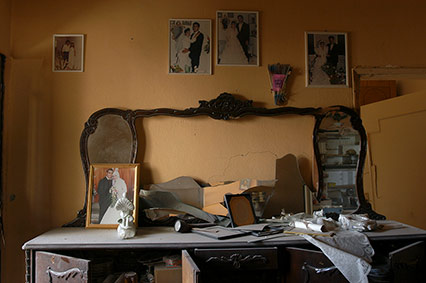
Somewhere in the passage of an ordinary day, inside a familiar yet
estranged room, everything has come to a standstill—frozen in a vague,
uncertain moment. Which day? Which house? Which city? The day the mirror
collapsed within its own frame, the flow of daily life decayed, and that lace
tablecloth was set aside. A place where life twisted upon itself and time stood
still—just before the photograph froze it forever.
“Sorrow and grief enter my heart. I am afraid of death.”¹ The brides
in the frames—ornaments upon the room’s walls in the heart of that life—gaze at
us like witnesses to this ruin, bearing testimony to the guilt. The
photographs, mementos of what we call "life," remain untouched and
intact on the wall amid the turmoil—as if only to reinforce the presence of
death in this still life. For the photograph speaks simultaneously of “what
once was” and “what is no longer.” They too have descended into death—just like
everything else in this room: like the youth of that man, whose tiny portrait
reflects from within shattered mirrors and gazes at the photographer through
layers of dust; or that broken door in the lower right corner, which leads
nowhere.
Death has slipped through the half-open wardrobe doors and now rests
quietly, silently, upon the furniture within—on the warmth of the wall’s color,
on the mirror’s empty frame, on the window to the left, from which even the
light fails to bring life. No one is here. “Silence speaks in a thousand
tongues.”² Only "war" lives in this house now.
1- Smith, George. Gilgamesh. Translated by Davood
Monshi-Zadeh, 2021, 4th Edition, Akhtaran
Publishing.
2- Shamlou, Ahmad. Ebrahim
in the Fire. 13th edition, 2019,
Negah Publishing Institute.