
Text
Sara YektapourStatic Motion
Each photograph has a fluidity that can settle into different contexts. It
is a fragment, detached and free, not limited to a fixed before or after.
This picture attracts attention precisely because of its ability to nestle
right here—more than its counterparts in the same collection. This familiar
photograph settles among memories of road trips and creates the illusion of a
firsthand experience. It’s as if it never belonged to anyone else and has come
to you through the image. A journey whose beginning and end are variable, and
only the path can be constructed and recalled through imagination and memory.
Sometimes it settles between a story or a travelogue, and its image replaces
the idea you had formed in your mind with those signs.
“The driver, whose throat had just been scratched, drove faster. On both sides of the road were hills and mountains. Our car slipped and passed like a wounded rabbit on the dusty gray road.” 1
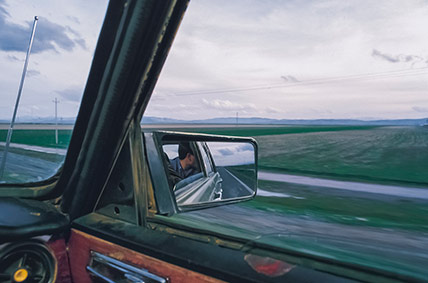
In this picture, an intermediate situation is fixed forever. A constant
uncertainty, but this time a pleasant one, whose beginning neither I nor my
companion—whose window is obscured—can see. From the mirror, I only get aimless
paths. A beginning that surely existed, but now is nothing but a flat horizon.
As if the entire path had been like this—a fixed, eternal road with my
companion(s), whose number and shape I do not know; except a young boy, like
me, fading into the road.
And finally, an ending beyond the frame. The photographer either didn’t want
to show it, or it too, like the beginning, was a horizon where the green earth
met the white sky; fixed, unclear, and seemingly eternal. So perhaps it’s
better to stop struggling and believe that all that is in the frame is
everything I need to see and know.
“The air was so gentle. I closed my eyes and took a deep breath. I told myself: how wonderful it would be if it never stopped and always kept going, for hours, days, and years! 2
1.Isfahan, The half of the world; Sadegh Hedayat; 1932; Fardin and Brother Publication; p. 6
2.Ibid, p.10