
Text
Pouya KarimLost in the dog
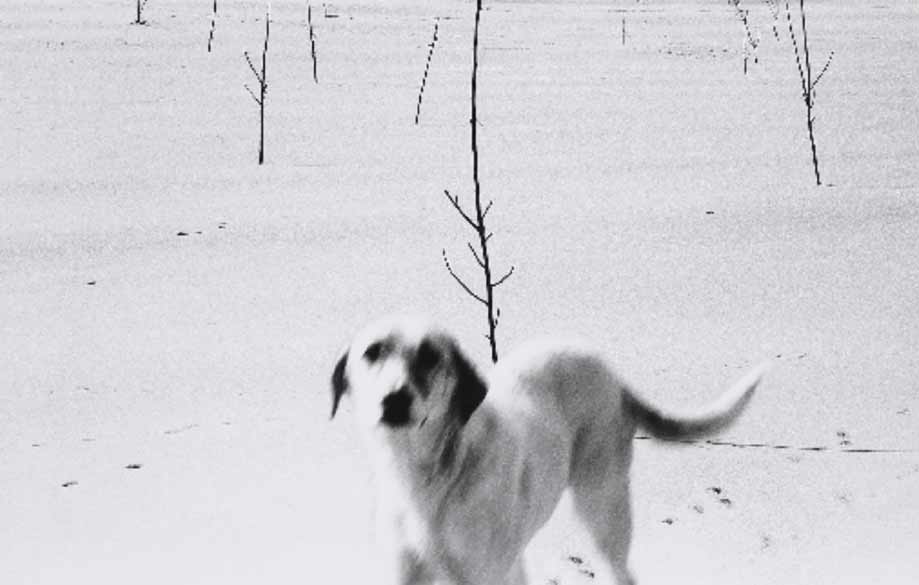
What does the encounter of the animal’s erased look with those two glassy
delicate and nature-attuned eyes want to convey? I believe the beauty of the
photograph on one hand lies in the mutual fixed stare between animal and human
and on the other hand in the mysterious and hidden meaning of the animal’s
face. Sometimes the picture looks at my unconscious gaze, and suddenly it makes
visible that invisible state as a unique event happening only once: the
asynchrony and imbalance of face-to-face meeting between animal and human, a
plant sprouting from its body, the grotesque skull-like distortion of its head,
the ghostly brushing of its tail against the shadow of the plant, the emergence
of the invisible traces of its paws on the bright snow.
In my memory Schubert’s Andantino music accompanies the photograph and
speaks of the secret of the lonely gaze and the lost innocence of the animal in
the dark pit of the world. Suddenly the dog falls upon the millennia-old snow
like a shadow, silence, stillness and in a moment of wonder between leaving and
remaining and it hesitates on the endless whiteness of life exactly as it is.
It realizes that it stands seemingly outside its natural body amid the whispers
of thousands of fallen leaves, strange and alien to the trace of its paws in
the burning depth of the snow where everything is vague and obscure and it
grows lonelier with every breath. Now it has nothing but a ghostly shadow that
both exists and does not.
Does Abbas Kiarostami’s dog’s
stare, like Robert Bresson’s donkey in the film Au Hasard Balthazar,
witness another human tragedy unfolding?