
Text
Farzin AzarmThe Embodiment of a Collapsed Dream
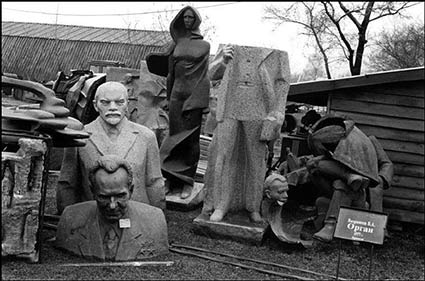
This photograph does not capture a "decisive moment" but rather a
historical one. The tilted frame and the harsh and sharp lines throughout the
image speak of decay and disintegration. We can tell it is winter from the bare
limbs of the trees in the background. Fragments of stone, gathered from the
scattered corners of a fallen empire, converge here to embody a single meaning:
the end of the Union of Soviet Socialist Republics.
The statue of Alexei Kosygin, ahead of the others, appears to be sinking
into the ground. The industrious diplomat of the Cold War era, head bowed,
stares at the earth in this cold silence. His chest still bears the medals of
Lenin’s honor. In this symbolic resurrection of monumental Soviet figures,
Kosygin seems to sense Lenin not in the glass coffin before the Kremlin, but
looming behind him. And yet Lenin, resolute and dominant, stares straight at
us—at the camera. Even his gray tone differs subtly from the rest, closer in
hue to the gray sky above. The sacred leader of the Bolsheviks, whose writings
were once holy texts to his followers, is now nothing but a stone
embodiment—cold and lifeless.
Now, Mr. McDonald has replaced Lenin. The Soviet people who once stood in
endless lines for him now, in Russia, queue for American burger chains. At this
historical juncture, Russians have become consumers of a dream made of circular
patties—headless, like the statue standing in the photograph.