
Text
Sara YektapourAnother
City
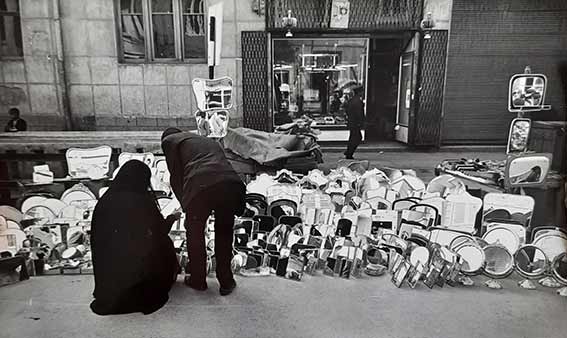
In contemporary photography many works can be seen in which breaking and fracturing a single fixed viewpoint—to expand our perception of space—is the goal. Here, on this two-dimensional surface created by a monocular tool, a part of the city is reflected hundreds of times, and from hundreds of frames and viewpoints in three dimensions, one can see a view of the city. Once again, it is one of those moments when words fail. Just seeing what is reflected in the mirrors and glass—and captured instantly—penetrates thousands of points in the mind. I watch the scene opposite this one in the picture, broken, skewed, and distorted in the mirrors; fragments of pedestrians’ bodies in different mirrors and angles of the subjects in the foreground that can only be seen in the mirror. Even the backs of the mirrors can be seen through another mirror. Everything that physically should be hidden from my view is instantly visible in one of these polished shapes. With my hands, I limit the frame and only look at the mirrors on the ground. These collapsed forms, showing hundreds of scenes, reveal the space in front of which the photographer stood with their camera. The mind cannot imagine a coherent space from this fragmented image. Could it be that I am watching parts of the photographer’s body without knowing it? The view reflected in the window glass is also skewed and distorted—amorphous and formless. Finally, I end my viewing of the photograph at the storefront window, in a combination of what is behind the glass and what is right in front of it. The picture is full of reflections based on the scene opposite and also the most deceptive image of that scene; reflections from which I can guess realities based on my observations but cannot arrive at any true representation of what is being reflected—just like the experience of viewing any other photograph.