
Text
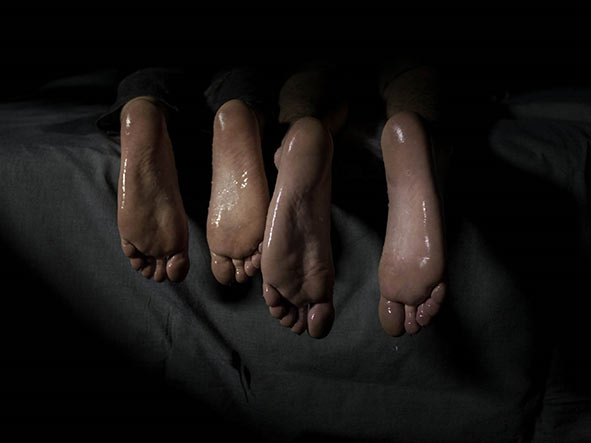
Ghazaleh RezaeiThe wet soles of two bodies in
the center of the photograph face us, while their bodies are engulfed in
darkness. I first saw this photograph in De Grote Kerk church in Breda,
in the area of the tomb monument of Engelbert II of Nassau, Lord of Breda, and
his wife. The reclining statues of both lay beneath a stone carried on the
shoulders of four men from its four corners. Opposite this memorial, a
large-scale photograph of the soles of Niousha Tavakolian was displayed. I
recall sitting cross-legged, looking at the wet soles within the photograph
beyond the tomb monument, while simultaneously seeing the stone feet of the
statues. The shine on the soles in the picture came from the light reflecting
off their wetness, while the shine on the statues’ feet came from light hitting
the polished stone. Do these two figures lying within the frame know of each
other’s presence? Their bodies are so close that they might feel each other’s
moisture or sweat. Are they even awake, or like Lord Breda and his wife, are
they peacefully still and lifeless? Perhaps because my first encounter with
this image was in a church, each time I see this picture, it evokes in my mind
Andrea del Mantagna’s Lamentation over the Dead Christ.
There, the lifeless body of Christ lies beneath a white shroud with arms
raised; here, two figures—perhaps a man and a woman, or a child and a parent,
or something else—lie on a bed with a gray sheet. In the painting, the
deliberate violation of one-point perspective directs the viewer’s gaze to
Christ’s lifeless face; here, we see only part of their calves and deep
darkness. There is no Mary or John lamenting over the dead body as in the
painting. Yet in my imagination, it seems Mary and John have been so overcome
by grief that it has drained their strength and taken their senses. I mentioned
Mary and John—what if, upon seeing these two feet in the photograph, we recall
the filthy feet shown in Caravaggio’s paintings? Speaking of those dirty feet,
I want to imagine these belong to two of Christ’s twelve apostles, whose feet
the Spirit of God humbly washed the evening before the betrayal. Is this water
capable of cleansing the impurity of Judas’s feet?