
Text
Ghazaleh RezaeiI went to the desert; love had rained, and the earth was moist.
So that as one’s foot sinks into the snow, into love I sank.
From prayer, I saw nothing but the standing of the body, and from fasting,
nothing but the hunger of the stomach.
What is mine is from His grace, not from my action.
Bayazid Bastami
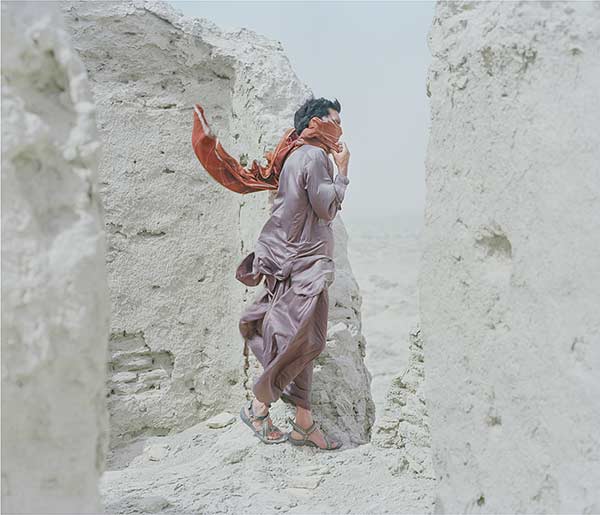
The picture has no color. The ruined bricks are white, and the checkered and
protector shawl is brick-colored; the sky is dull and pale, and the shirt is
radiant lilac. It seems that lilac, brick, and the gray dust of Mohammad’s hair
are the last remaining colors in the image. The lament of the wind echoes in my
ears. Forty-something Mohammad wants to move at any moment—neither the Mohammad
who was called on at forty in Jabal al-Nour, nor the Sultan-ol-Arefin
who said, “I went to the desert; love had rained, and the earth was moist.” If
I didn’t see his shoes in the photograph, my mind would wander elsewhere. But
can a pair of modern shoes limit the imagination of a human? In this desert,
neither love has rained nor the earth become moist. Even amid the remains of
the mosque in the former village “Takht Shah,” Mohammad has not escaped the
lash of the wind of this era, let alone stride “as one’s foot sinks into the
snow and thus into love.” Many have been those who, during the lifetime of this
abandoned mosque, “saw nothing but the standing of the body from prayer and
nothing but the hunger of the stomach from fasting.” The dryness and the “death
of Hamun” do not let me accept that “what is mine is from His grace, not from
my action.” Neither grace nor action exists. It seems we remain with only the
clamor of the wind in this barren land.