
Text
Mehran MohajerThe Crowd of a Photograph
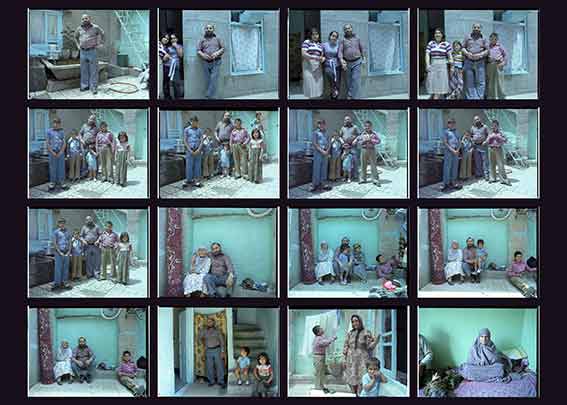
Sixteen photographs sit side by side on a single contact sheet.
It’s as though the photographer didn’t wish to choose just one or a few among
them. Perhaps they wanted us to choose. Or perhaps they wished for us to see
them all together — to read them as a single, collective text.
A working-class family lives within the confines of this small sheet. The
courtyard is just as small. And yet, this large family has gathered closely and
in harmony within its tight and narrow bounds. The photographs tell us that the
man is the center of the family. In fourteen of the images, he stands or sits
at the heart of the frame. In one, a woman takes center stage,the man is only
half present, half absent. In another, two young boys appear: one looks into
the camera from in front of their mother; the other gazes upward and outward,
beyond the frame, from behind her. I have no idea where that woman is now, or
where those two boys stand in their family’s story today. To find the answer,
one must look to the profound transformations of these past decades —though we
must let go of the desire for a simple, linear response. The richness of detail
in these images is overwhelming. It pulls us into the lived world of these people
—a world that flows beyond the flat surface of the photograph. We see the wheel
of a bicycle and the saddle of a tricycle. How do these wheels turn in such a
narrow courtyard?
Where in the broad composition of these images will the rolled-up rug be
unrolled?
Where is the kitchen, where the empty aluminum pots, stacked on top of one
another, might sit over a fire? Do the stairs lead to the rooftop, or to
another family’s tiny room?
What language does this sheet of photographs speak? The cropped corners and
tight frames speak of limited space, while their side-by-side arrangement
suggests a yearning for openness — for breaking free of that confinement. These
photos are now in their fifth decade. The children within them must now be in
their fifties or sixties. And yet, their deliberate assembly on this page has
given rise to a new architecture —a new expression. This layered construction
seems to speak something of that time. And its many-voiced expression seems to
ask something of it, too. The secret of this contact sheet lies precisely in
these acts of saying and asking.