
Text
Sara YektapourMay the Black Dog Not Eat You!
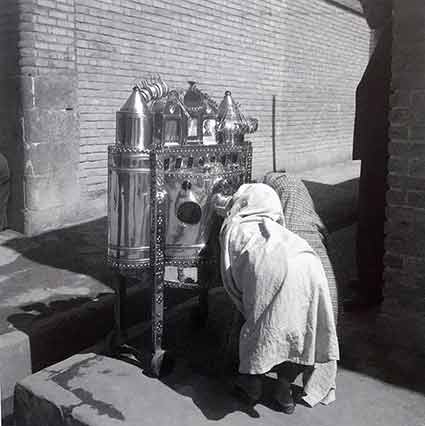
I wish I could see what lies behind that peephole. I’m curious to glimpse the
images that, for a moment, separated those two from their surroundings—images
of a world rarely found elsewhere. I watch the peep-show carefully, hoping some
of it might reach me, the elsewhere-unvisited lover of elsewhere. I try to
recall a time when an image was something fresh to me, not yet saturated with
pictures from all over the world, to understand the wonder that seeing these
scenes could inspire in someone.
Perhaps it is because I have seen so many images that this time I am denied seeing what lies behind the eye. Yet this peep-show does not leave me empty-handed with just these two images: a portrait of a woman and a man up there, although very small and distant.
Two figures, wrapped in veils, are watching yet themselves
remain unseen. From them, as much can be seen as from the peep-show itself. The
intersection of face and eye conceals both the visage and the image.
From the center of the frame, I moved to the edges and searched the shadows, where I noticed the presence of a man standing on the right. I was so immersed in watching the glitter of the peep-show that I missed his fixed, dissatisfied stare. His gaze, like every sharp, observing look, suddenly interrupts my act of watching—as if the show itself had said: “May the black dog not eat you!”*
*After the peep show ends,
the "Farangi"—the show attendant—lowers again the curtain installed
inside the box over the magnifying glass lens, blocking the view of the image,
and declares the end of the show with the phrase:
“May the black dog not eat you!”
Source: Dehkhoda Dictionary