
Text
Farzin Azarm
Robert Smithson, in his essay “A Cinematic Atopia”*, refers to the immersive atmosphere of the movie theater during a film screening—how the darkness and ambiance of the theater have the power to alter the viewer's perceptual pathway and, through the film on the screen, transport them into an alternate reality.
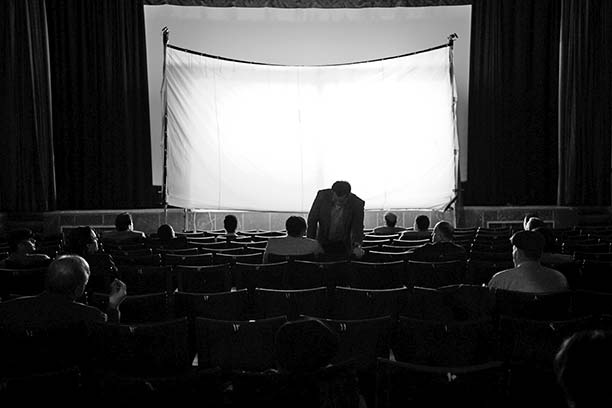
What’s at stake here is the passivity and alienation of the individual in the face of the apparatus's rituals. "The individual forgets where they are sitting... As the eyes are busy dissecting the cinema screen, the outside world gradually disappears." In this context, what is projected on the screen is not merely an image, but an ideological mechanism that, in Louis Althusser’s terms, interpellates the subject—establishing an invisible yet fundamental link between the subject and the dominant order. In Takhtkeshian’s photograph,this ideological interpellation is felt in the tension between blinding light and silent bodies; what is visible and what remains in the dark is governed by this hidden order.
We are faced with individuals who, under a shared name, have been rendered nameless: extras—people who walk among facades and cardboard sets, waiting for the script supervisor or director to call them forward to the camera. Now, within a newly constructed semantic context, they themselves have become the leading role. A world built out of another world—a world selected through the sequence of images.
Sources:
Althusser, Louis. Ideology and Ideological State Apparatuses, trans. by Roozbeh Sadrara, Tehran: Cheshmeh Publishing, 2007.
Bishop, Claire. Installation Art, trans. by
Visheh Khatami Moghaddam, Tehran: Mehr-e Nowruz Publishing, 2017.