
Text
Mahtab GhaediRemaining Witness
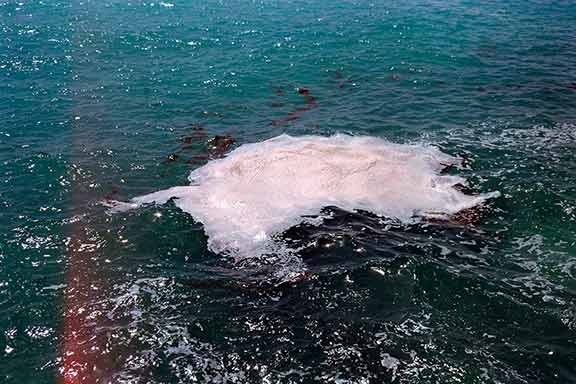
A foam-like patch is visible on the surface of the sea. I don’t know its
nature, but it gives me a familiar feeling — a dread of something unknown and
ominous. It may be full of living particles, yet it still carries death;
suspended between the beautiful and the repulsive.
Where the mind cannot comprehend what it faces, it begins to imagine. At one moment, it resembles a floating carcass; at another, a white cloud that has suddenly descended upon the sea’s surface. This is the point where the image approaches abstraction, somewhere between sight and imagination, between reality and fantasy.
Beneath this whiteness, a streak of red is hidden—not
clear enough to be certain, yet not faint enough to go unnoticed. It resembles
blood; a trace of something that should have been forgotten but remains. The
contradiction between the calm sea and what lies before our eyes stems from the
absence of something unseen in the image but felt in its presence. The red
stains left on the negative after film development intensify the imagination of
blood streaks, as if memories of the sea have erupted onto the memory of the
photograph.
I remember Icarus—not as in the legends, with passion for flight, but as
depicted in Bruegel’s painting in the margin. His body is no longer visible;
only his legs remain, sinking into the sea. No one watches, no one stops. The
fall happens without an audience. This patch feels the same to me: a moment
after the fall, the remnant moment after disappearance.
I think of the sea’s victims, of faded traces, of a crime scene that erases
everything within it—even this patch. And the only thing left behind is the
image: a witness to an imaginary death.