
Text
Mehran MohajerUnfinished Gray
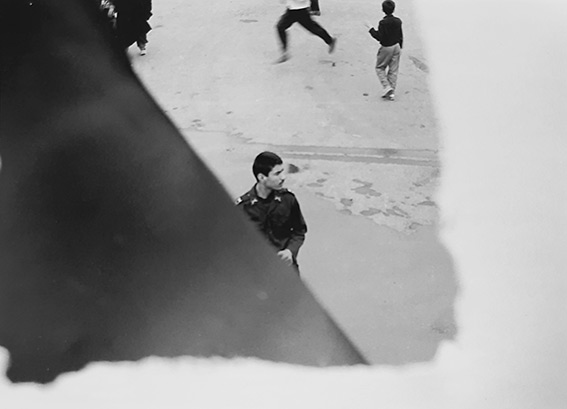
Sadegh Tirafkan’s photographs fundamentally rely on the language of
performance. But here, it feels as though we must look behind the stage, behind
the curtain. Yet, the curtain never fully falls. The photograph itself is one
whose essence is ambiguity, and that is precisely what makes captivating and
striking. To interpret the picture, I cling to its title. The title tells us
the location: a cemetery. It also sets the date: 1989 (1368 in the Iranian
calendar). We can more or less read the elements within the picture: a soldier,
two children, and a woman. Everything is left incomplete and half-finished. The
bodies are fragmented. It’s unclear where the soldier is looking, nor do we
understand where the child’s gaze falls. Nothing reveals where the other child
is running toward, or where the woman might step amid this rupture. The
photographer himself stands above these four figures, yet his position seems
unstable and uncertain as well. The crooked, distorted frame within the photograph
tells us this. This framing is what captures my eye the most. We see the scene through
two irregular edges, a diagonal side, and the top edge of the photograph.
Perhaps the photographer is not looking from behind the curtain but through a
rusted mirror. This disorder—or, as Hafez would call it, a Nazm-e Parishian
[disordered order]—unsettles the mind and the eye and releases them into the
unknown.
In the midst of this unknown, in this place, and with these incomplete
bodies, the only certainty I have is that we stand at the border of death’s
time. The title of the picture reveals it. A death confined within dirty grays.
The photograph itself tells us this too. But there is no escape; this very “disorderd
order” of the picture tells us that we must move beyond this scene, beyond
these ashes and this frame. Life is there.