
Text
Ghazaleh HedayatHave a Break. Pictures that remained silent
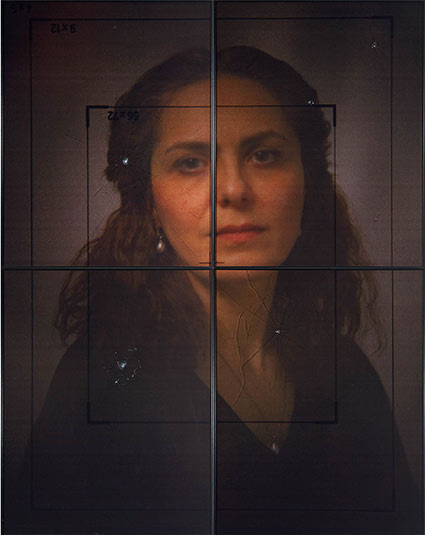
She sits there, her eyes are looking at us from every direction. Is she calm
and peaceful or longing to rest? I don’t know.
The image is divided into neat pieces by the guide lines on the frosted
glass of the large camera. Each piece brings us closer to the image to look
more closely and meticulously at that part. The image is not sharp and doesn’t
have the clarity of today’s pictures. Her gaze is on us. The background is
dark, and the softness of light flickers on her face. The smile on her lips and
a pale earring in this darkness draw me in. That same earring, with its faint
sparkle, leads me swiftly from this photograph into the heart of a Vermeer
painting. Back and forth, this photograph and that painting keep pulling me.
Here, that strange headscarf is missing; the photographer has let her hair
loose. We are not stunned by that sudden glance as if the painter stole it. The
subject/photographer looks at us calmly, or we look calmly at her. Due to the
mirror-like image, the earring has shifted from the left ear to the right ear.
And a few steps beyond that, I step back one hundred and fifty years before
Vermeer and distance myself a bit from that painter’s gaze and light to move
from the white earring to that fleeting smile.
Now I pass through that glass and photograph and reach the poplar wood
panel. Half Da Vinci, half Mona Lisa,
here the photographer and the subject have become one. And it seems at this
exact moment the crack in the glass and the cracks in the layers of oil paint
merge. I look at the fracture of the photo’s glass or the crack in the
painting’s skin—or the skin of the face, I don’t know. Mona Lisa, or that
joyous one, with these cracks and the constant sound of breaking, her faint
smile fades from memory. I return here again. And in the next image, I see a
person; in one there is calm, and in the other there is anxiety and fear. The
one sitting calmly is the photograph’s subject, and the one who unsettles me is
the photographer, who has aimed herself with the cross at the center of the
image. The plumb lines are set in motion. It’s as if these plumb lines, which
balanced the pictures, broke them, dried up the smiles, and made Mona Lisa
pregnant with death.
But in the next image, I see myself—a woman walking among the brilliant
paintings of art history, hearing the gaze and whispers of each for a moment,
remaining silent, then stepping back to move in step with the history of
photography, to see how subject and object have consciously become one and to
see how the desire to see and be seen merge. And again, I see that I can sit in
any of these places. It doesn’t matter whether she is Vermeer’s daughter or his
servant, his lover or his wife, whether she is Lisa Gherardini or Da Vinci,
whether Mona Lisa is pregnant or joyful after giving birth, whether she is
Katayoun Karami or any other woman—I can sit there and here, I can look at the
painter, the photographer, I can look at her and see myself.
The plumb lines are set in motion again.
*This text was previously published in Herfeh: Honarmand art magazine,issue 61.