Bāygān: House of Photographs and Words
Photo
Habib Farshbaf
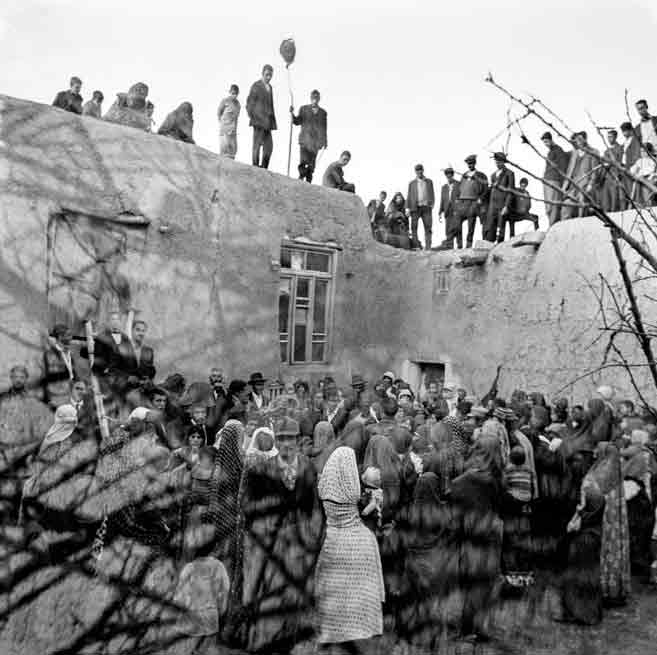
Gumusava Village from the Series The Araz Riverside
1969

Text

Mehran Mohajer

Chiaroscuro
Thanks to Farshbaf’s photographs, I become acquainted with a part of culture, a part of our home from a not-so-distant past. I also enjoy his photography which is both meticulous and joyful. But the story isn’t just that. Some pictures enchant me. One of them is this very photograph. It is a wedding celebration in a village, Gomushava; and a crowd of people gathered together. Some are busy with their own tasks, and some are staring at the camera. Those who are busy are engaged in the festivities. But those who look into the lens—I don’t know what is going through each of their minds. What image do they imagine will appear in the final picture? These individual gazes amid the crowd stir my imagination to construct my own image. And perhaps the most fanciful image is in the eyes of the man holding a stick atop the roof.

The photograph does not end here; chiaroscuro is the other magic of the photograph. The network of shadows cast by the trees falls more or less everywhere, and this interplay of light and shadow weaves the layers of the photograph together. Women and men, women and men and the village buildings, and all of these with the absent nature—meaning the shadow of the trees. In the visual tradition, chiaroscuro is mostly used to create volume and a three-dimensional effect. With this three-dimensionality, a two-dimensional image approaches the real world. But here, chiaroscuro, with its interweaving creates a collective imaginary memory of home.

Some of the photographer’s striking pictures result from the accidental overlapping of two images. I am naively eager to know whether this is also such a case or not.