
Text
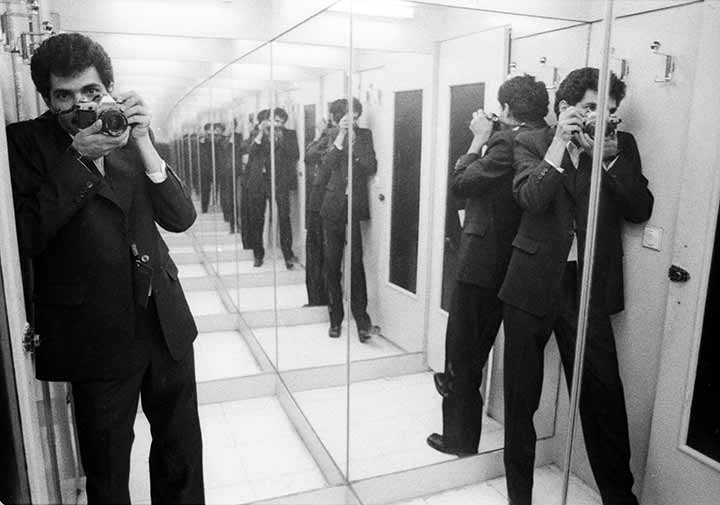
Pouya KarimSelf-Portrait in the Fitting Room
The self-portrait in the fitting room is a staged scene in which the
subject’s face is fragmented through the endless reproductions in mirrors. The
confined frame of the fitting room—mediated by the subject’s skewed gaze—turns
into an open threshold, confronting them with the tragedy of a multiple,
heterogeneous self. From this perspective, the mirrors, through their virtual
reflections, remind us that the subject is never a unified or singular whole.
They are fragmented—pieces that, within the mirrors of memory and society, are
always at risk of disintegration.
This fragmentation is not a weakness but an inherent part of the subject’s
lived experience. On a micro level, the element that wounds most is the price
tag or label of the new clothing—a commercial and economic symbol that, before
anything else, frames "identity." It suggests that even the personal
and private are rendered meaningful within networks of power. In this way, the
photographer’s self-portrait reveals this hidden intimacy, expressing how the
symbolic order both brings the subject’s body into visibility and
simultaneously confines it.
The photographer’s gaze is not a mere invitation to look—it is an
intervention against the viewer’s desire for stability and stillness. It is the
tip of a spear that pierces the very heart of fixed identity. The photographer
asks the viewer to reexamine the rituals and frameworks of representation—those
that have been repeated for centuries through art, advertising, and everyday
culture. Thus, the image before us is not simply a self-portrait but a visual
text—an implicit critique of the power structures that construct identity, and
at the same time, a critique of the tension between individual autonomy and the
imposed roles of society and institutions.
This, I believe, is the photograph’s most valuable achievement: the creation
of a space for rereading “identity”—not as something immutable, but as a fluid,
historical process that is always in the making.