
Text
Pouya Karim
Looking at the Garden
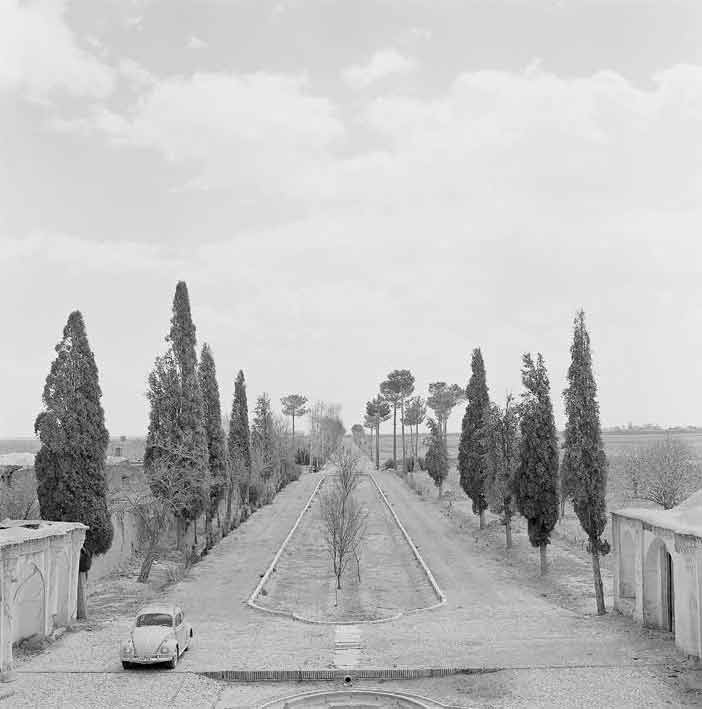
Nikol Faridani’s photograph is
a document of a half-dead, breathless paradise. The Persian garden—with its
shade-casting cypresses, luminous pools, and flowing streams—has always
embodied eternity and celestial order. Yet in Nikol’s frame, the image of
paradise collapses. An empty pool, withered trees, and dried-up channels evoke
a silent death. The garden’s stillness is not peace but absence of life—like a
land long trapped in the narrowness of repetition and ritual, no longer
possessing anything new to say.
Suddenly, in a corner of the
frame, the presence of a Volkswagen Beetle appears like an ill-matched patch in
the heart of this faded landscape—a rusted nail in a mud-brick wall. The very
same car that, in Nikol’s eyes, was a source of the joy of travel and with
which she lovingly traversed Iran. This incongruous presence pulls the image
out of the nostalgic postcard frame and turns it into a historical document.
Indeed, mismatched patches often speak the truth. Just as Robert Frank
portrayed America in The Americans through the road and the automobile,
Nikol likewise recorded Iranian modernity in the form of a modest German car.
Now the garden is no longer a
garden, and the Iranian dream has dissolved into smoke. The car marks the
moment when modernity transformed Iran’s face—not through the language of
industry and law, but through oil revenue and imported commodities. Within this
frame, an uneasy rift emerges between the dream of tradition and the reality of
the modern. Tradition and modernity have always been seated opposite one
another—one praised, the other condemned. Yet this very binary opposition is
itself a product of the modern perspective.
That mythical tradition so
often invoked never existed in and of itself. Tradition only reveals its face
once modernity enters the scene—not as a living inheritance, but as a lifeless
and ideological commodity. Thus, the Volkswagen in the Persian garden exposes
an unbridgeable rupture and becomes a sign of modern history. In this way, the
totality of modernity appears in a random detail: a German car beside an
Iranian garden.
For this reason, the garden
and the automobile do not truly confront one another; rather, they are two
faces of the same game. And we, in the midst of this game, like the Angel of
History, keep our eyes fixed on the past while the storm of modernity drives us
toward the future. We have neither the power to stand still nor the possibility
of return. What remains is a frozen suspension: between an uninhabitable past
and a jolting present. This untimeliness is our existential truth.