
Text
Mehran MohajerHalf of a Gate
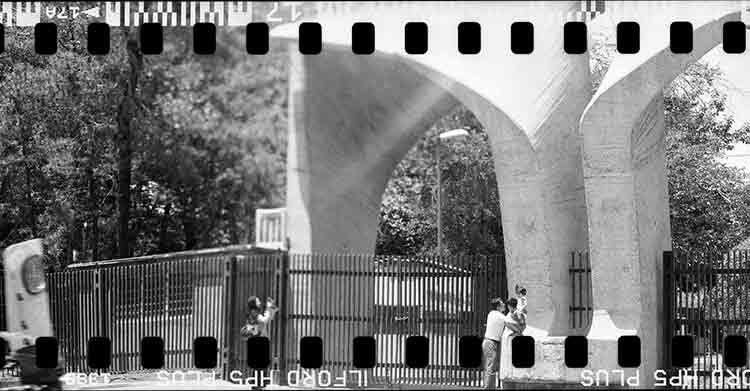
The film’s trace is visible with the blackness of the holes and the
whiteness of the reversed letters and numbers. It seems intentional,
emphasizing the act of photography itself. The wide or panoramic frame also
stresses this emphasis. However, the act of photography flows both ways and
extends into the scene: the scene is a family photo session.
The location of the scene is familiar—the gate of the University of Tehran.
Yet, the situation is somewhat strange. Taking a commemorative photograph
against a background that carries the heavy burden of our era’s history is
peculiar. It is even more unusual that the mother takes the role of the
photographer, while the father is responsible for holding and arranging the
children. It’s as if, in contrast to the tradition of hidden mothers*, here
we encounter a visible father and a mother as the photographer. Interestingly,
the mother is busy taking the picture, the two children are not paying
attention to the camera, and the father stands openly in front of them, unlike hidden
mothers.
This photograph narrates a micro history. A history that emerges from the
intersection of the University gate and the four-person family snapshot. Both
the act of taking a family picture and the view of the University of Tehran
gate are ordinary—they have been seen many times, even on the fifty-toman
banknote. Yet, amid these ordinary matters, the strange is no less present: the
reversal of gender roles in the act of photography, the disappearance of the
woman and the clarity of the man and children, the closed university door—a
door that has been shut for years—and that fifty-toman note which no longer
exists.
*Hidden mother photography is a genre of photography common in the Victorian
era in which young children were photographed
with their mother present but hidden in the photograph. It arose from the need
to keep children still while the photograph was taken due to the long exposure times of early
cameras.