
Text
Farzin AzarmClots of Memory: Rupture and Continuity in Sonia Balassanian’s Installation
Dedicated to Kasra Heidarizadeh
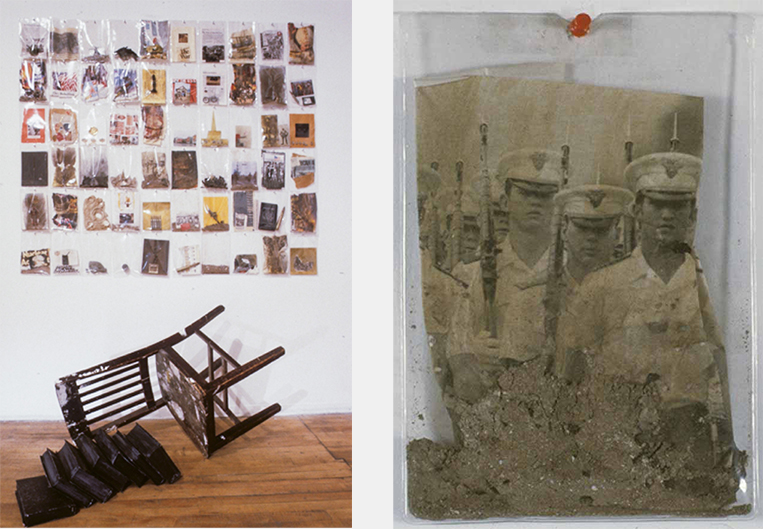
In Wrapped
memories in plastic, Sonia Balassanian explores the representation of
memory in a state of suspension and frigidity. The work’s structure relies on
two visual poles: a wall covered with transparent plastic bags, each containing
objects, images, and fragments of texts or magazines; and, in the foreground,
an overturned chair beside a cluster of black books scattered across the wooden
floor. This duality between the wall-as-archive and the floor-as-ruin generates
the work’s fundamental tension—a tension between the desire to preserve and the
necessity to forget.
In this
piece, plastic functions simultaneously as a protective and restrictive medium:
a material that prevents decay and corruption, yet also suffocates and
obstructs touch. From this perspective, memory in Balassanian’s world is not a
living, fluid phenomenon but a sealed and archived body—a corpus of
recollections and signs that in the very moment of preservation becomes devoid
of life. Each bag serves as a capsule for the remains of experience, a sign of
a past that can no longer be fully narrated: fragments of rope, feathers,
printed matter, and photographs that seem to emerge from a lost event or a
buried catastrophe. These dispersed elements form a fractured, discontinuous
language that hovers between archive and nightmare—a language especially familiar
to the migrant and exilic subject.
Within
the composition, the overturned chair holds a central role. In Western visual
tradition, the chair often signifies the seat of thought or the presence of a
human subject. Here, it has become a symbol of absence and instability. Its
inversion acts as a metaphor for the collapse of the subject in confrontation
with history—a subject that has lost its place and remains suspended among
inanimate objects and ownerless memories. Alongside it, the black books
resemble silent tombs of knowledge, underscoring the failure of historical
narration and the incapacity of language to articulate pain and exile. Thus
Balassanian’s installation becomes a kind of negative memorial—a
monument to what has been lost, forgotten, or never granted the chance to be
spoken.
Wrapped
memories in plastic can be read as an outgrowth of the artist’s lived experience—an
existence stretched between two cultural geographies. Born into Iran’s Armenian
community and living in the United States since the 1970s, Balassanian addresses
in her work the question of migrant identity and memory: a memory that is
fragmented, asynchronous, and polyphonic rather than unified or linear. In this
installation, too, memory is rendered through material objects and fragile
archives—objects whose survival depends on being sealed within a layer of
plastic, just as memory itself endures only through its frigidity and through re-presentation
in art.
Despite
its formal simplicity, Balassanian’s work poses a fundamental question: does
archiving truly preserve and recall, or is it merely another form of erasure
and isolation? The artist’s implicit response lies in the poetic core of her
work: in a world perpetually threatened by oblivion, the act of keeping—even
when futile and contradictory—becomes a gesture of resistance: resistance
against erasure, against silence, and against the disappearance of memory.