
Text
Farzin AzarmIn the beginning, there was only a
blue light
In the beginning, there was only a
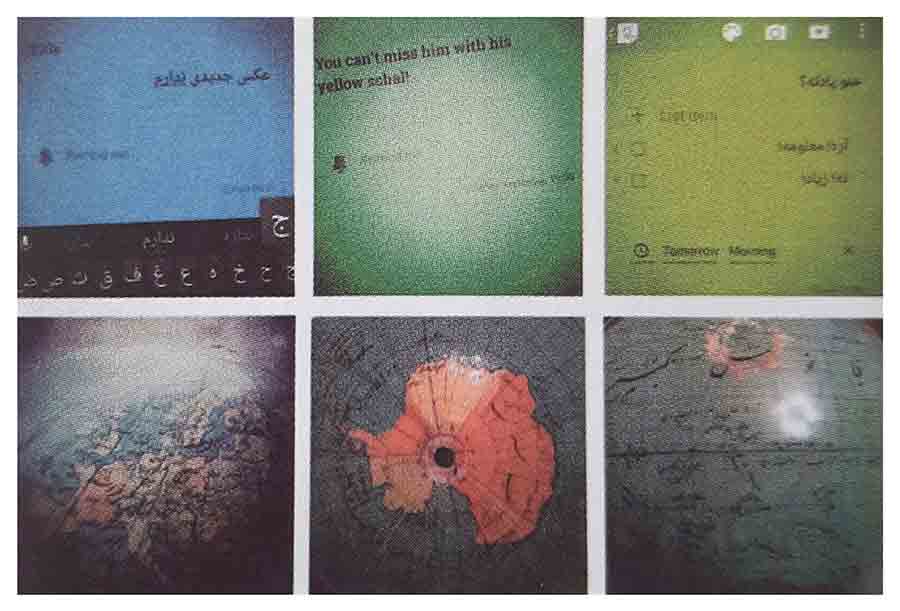
blue light on a small screen. A hand slid across it, leaving behind a few
words: “I don’t have any new pictures.” Right here, in the middle of a
sentence that seems unfinished, a world begins. An image that is made not from
the outside but from within the device—out of layers of memory and data, out of
the gliding contact between language and place. It is in such a moment that
this image breathes; somewhere between recording and erasure, between the
desire to speak and the inability to do so.
In the rows of this six-pane grid,
two surfaces of the world meet: one made of words and notifications, of
everyday messages, of the glow of screens that has turned into fragments of
conversation; and another made of maps, of lands whose colors have faded, of
continents dissolving into memory. Language pulses above, and the earth lies
silent below. Between them, an open distance remains—a distance in which every
user, every contemporary human, wanders: not inside the world, not outside it,
but on a plane of glass and light.
These images tell us nothing of
the external world; instead, they speak of living in a digital one, where
everything—from love to geography—has been reduced to data and pixels. Here,
language becomes a borderless map, and the map becomes a voiceless tongue. The
work is a memory of living in a time when the eyes have fallen away from the
world; a moment when photography is no longer merely the recording of reality
but the reconstruction of a moment after reality has slipped away. And perhaps
the image finds its meaning precisely in this impermanence: in the moment the
phone goes dark, and the earth returns once more to its silence.