
Farhad Yasavoli
Untitled from the series Memorial
2024-Ongoing
Text
Ghazaleh Rezaei“Not Syntax but Effacement.” ¹
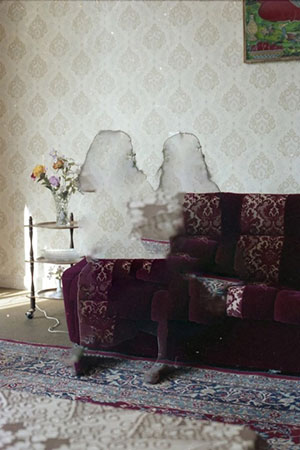
This image is new; Farhad Yasavoli created it just a year ago. Yet it is also
an old photograph, and according to him it goes back to the mid-1980s. Two
women, pressed close together, stand at the center of the picture, facing the
photographer of that time who had been sitting across the table taking their
picture. But the two women are no longer in the image. Yasavoli—now sitting
behind another table—has erased their faces and bodies. The photograph speaks
entirely of un-(being); do you see how the twisting bodies of the Shah-Abbas
floral motifs resting on the carpet are crushed beneath the erased feet of the
two women? Do you see how even those fake flowers we used to keep in waterless
vases in our homes are gone? What became of those crystal pieces that sat
proudly in the center of the table? Why do those lights no longer enter our
homes? Where does that coiled wire lead? Do you see how that vitrail, gradually
slipping out of the frame, glows green and tulip-like? Where did that green go,
and when did this drought arrive? Where are our vitrails?
Mom, do
you remember how your brother—who “did not know how to die” yet—took several
days to paint the glass of the patio in your childhood home? How lucky that I
too had seen it, even if I recall it through photographs of you and Dad, and
your brother’s face in just the same way. Do you know who it was, on the day
they tore down your house—who brought about that black day that shattered the
vitrail? Who ripped the carpets from the floor? Who tore your wallpaper? Do you
remember how Dad’s forehead and hands sought refuge on those walls and papers
in those days and nights after his closest companion, your brother, had died? I
watched all of it while crawling on these very rugs. When your house was dark
with mourning.
If, like me and the women absent from this picture, you had had a sister, would
your sorrow have been any less? It would have been, had you known. It would
have been, if you could forget2.
¹ Jalal
al-Din Mohammad Balkhi (Rumi), Masnavi-ye Ma‘navi, Book I, “The Story of
the Grammarian and the
Boatman.”
² Parts of the tone in this text are inspired by The Elephant in the Dark
(1979), by the late author Ghasem Hasheminejad.