
Text
Farzin Azarm"What is this? What am I seeing? What do I really know about this image?" I remember these questions from Terry Barrett—questions meant to describe a photograph. What am I seeing now? It is as if the image itself has opened the first chapter on the path to understanding. Sentences are attached to the photograph in the simplest, most factual way—sentences that seem to attempt the decoding of the image.
Siavash
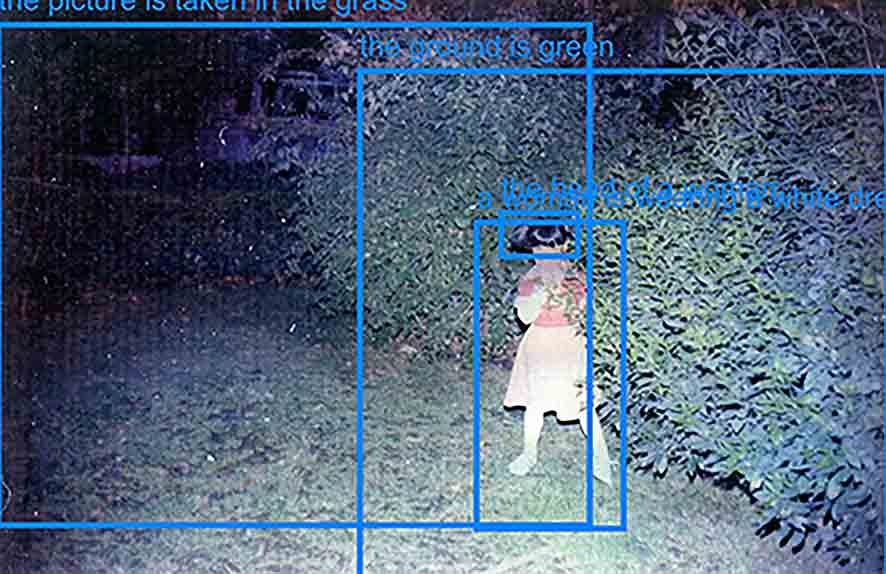
Naghshbandi presents a photograph that, at first glance, appears calm and
familiar: a child in a green space, the flash illuminating the grass and
leaves, a night barely visible beyond the light. The child’s body occupies the
frame but the face is half-hidden; the photograph pauses from the start between
revelation and concealment. The blue lines and simple words overlaying the
image point to elements of the scene without any poetic claim: the ground is
green, the picture is taken on the grass. The image introduces itself, but this
introduction leaves not assurance, but doubt.
This
doubt deepens with closer observation. Frames settle one after another over the
image, emphasizing some areas while erasing others. Each frame promises
understanding, yet simultaneously excludes something. The descriptive language
of the text is dry and precise, striving to reduce the world to simple
propositions. Yet the child, hidden behind the bushes, resists this order. They
are neither fully visible nor entirely deniable. Meaning emerges in this
interval—where the image refuses to submit to a single reading, and every
attempt at explanation inevitably remains incomplete.
In the end, what remains is not a clear message but a suspended experience. The photograph constantly forces us to move back and forth between what we see and what we say about it. Frames, text, and light all participate in an unfinished dialogue, in which no voice is final. Rather than delivering meaning, the image
opens up the possibility of meaning. Its poetry resides precisely in this
potential—in the moment when the look pauses and it accepts that the image is
always more than can ever be said about.