
Text
Farzin AzarmThe Ordered Ruin
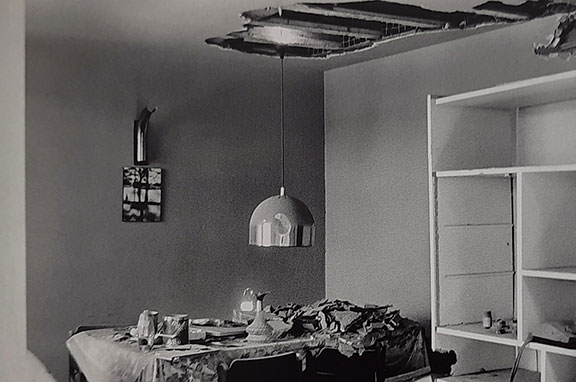
It is a photograph of war, yet it would be a pity to
describe it merely as a documentary image of war. The stillness present within
this ordered ruin seems to place it before our eyes on a more deliberate level
of image-making, almost like an installation. It is as though the destruction
before becoming a catastrophe has arrived at a silent order. The chosen
viewpoint to the attention paid to the details of the scene, the relationships
among the objects and everything else, make this photograph a true success. Yet
this frame should not be reduced to these qualities alone.
Its liminal space constantly unsettles meaning. It
refuses to fall neatly into any category: is it a photograph of an installation
artwork? A reconstruction of a collapsed roof? A still life? A war photograph?
I do not even think that postmodern claims such as “post-event photography,” or
similar labels, can adequately explain it. The image remains suspended,
unwilling to prove or report anything. Perhaps it is precisely this resistance
to certainty that elevates it beyond the level of a mere document and transforms
it into a visual and mental experience—an experience that speaks less about
narrating war than about the condition of looking at devastation. It captures a
moment in which the world has collapsed, yet the meaning of ruin has not yet
found its way into language.