
Text
Mehran MohajerNon-Place
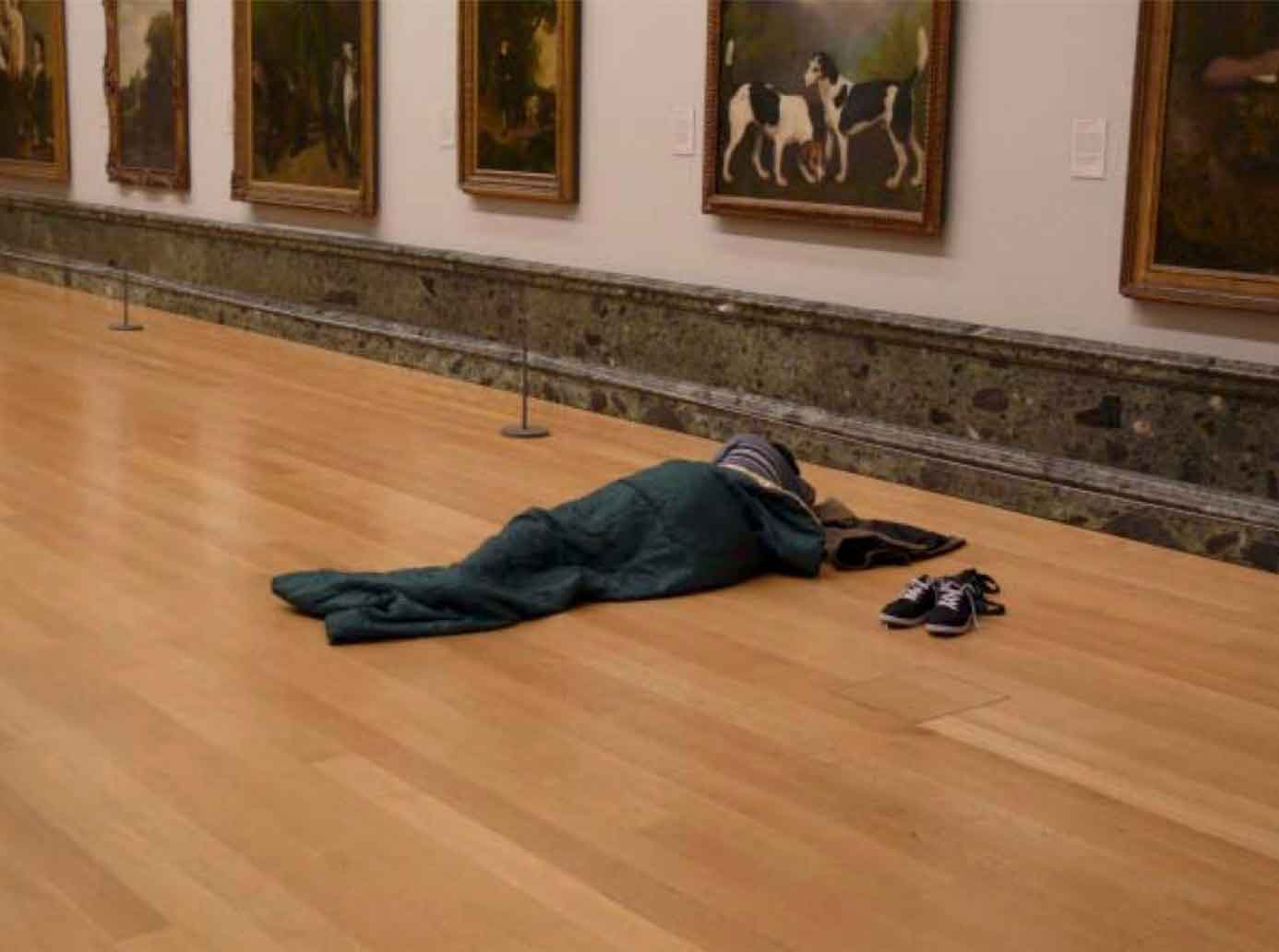
Where is this place? We all see it and understand that it is a
museum. But has this homeless not transformed the very function of the museum?
Today, perhaps the museum can be understood through the contemporary concept of
the non-place. Non-places are spaces of passage, not spaces for dwelling
and living. They are not places of encounter and human connection; within them,
people remain anonymous and nameless. In this sense the
museum, like shopping malls, stations, terminals, and airports, appears to be a
non-place.
A museum is not a place for meeting, but a place for seeing. It is
not a place for dwelling, but a place for lingering. One is meant to stay for a
while, and in one's own anonymity observe what the renowned have done and how
they have filled the repository of culture. But this homeless has not come to
see. He has come to stay. He has not come to look; he has come to sleep. By
sleeping here, he has disrupted the institutional logic of the museum. It is as
though he has sought to turn a non-place into a place. Indifferent to all these
masterpieces, he lies asleep. Perhaps the silence of history, rather than the
noise of the street, has granted him the possibility of rest. Yet despite this
act of dwelling, once awake he too must pass through this non-place again. His
name will remain absent from both the floor and the walls of the museum.
The floor has become more meaningful than the wall. We linger at
the center of this floor, while the half-cropped paintings on either side of
the photograph push us outward. We leave this history and move toward the
present—to a place that, for him and for many of the displaced, is itself a
non-place.