
Text
Farzin AzarmSomewhere
Outside the City
(In
this piece, I imagine myself as the photographer.)
When I could
get connected to the internet after several months, I discovered that Boards
of Canada's new album had been released. I wanted to listen to it in the
car while driving. At a time when connecting with other people seemed more
difficult than ever, driving had become one of the few remaining ways of
encountering the outside world. The city felt quieter than before—not empty,
but immersed in a collective, involuntary silence. There was still traffic,
though it flowed more freely, and somehow it seemed easier to endure than it
once had. Streets, unfamiliar routes, and roads with no particular destination
called to me more than ever.
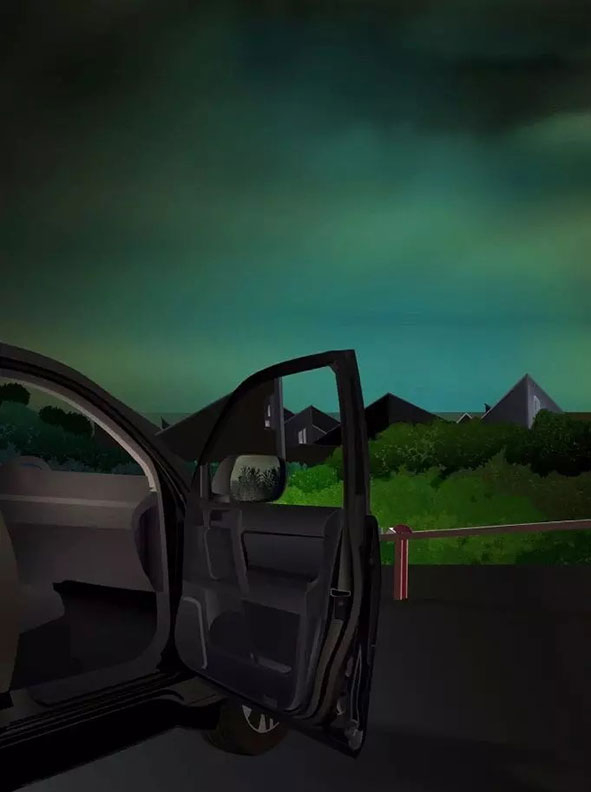
On a
relatively long local road, beneath a darkness faintly illuminated by the moon,
the icy lights of the highway leading toward the city center appeared in the
distance. The cool night air mingled with the rhythm of the music inside the
car. Pulling over briefly at the roadside revealed a scene that seemed to
belong less to an actual place than to the image of one: a small settlement of
tightly clustered houses. The houses looked almost ghosty, and the road
disappearing into the darkness turned everything into a suspended scene, a
place where it was impossible to tell whether you were standing on the suburb
or inside the memory of it—a place both inhabited and abandoned at once.
Night strengthens
this quality. It is as though everything withdraws from its everyday function
and becomes an image of itself. Houses with no lights on, a road untouched by
passing cars. The moment resembled a familiar dream. In such moments, an image
is no longer simply the record of a place; it becomes an encounter with a
particular condition of time and space, where the past, the present, and the
imaginary briefly converge.