
Text
Mehran MohajerThe Speck of Light and the Black Grains
A photograph is nothing more than a straightforward copy. Yet perhaps it is not so straightforward after all. By the very nature of photography—which is always an act of selection and omission—the photographer has excluded parts of what was copied. He has reproduced and documented but only in a diminished and incomplete form. The rectangle with its missing fourth side also points to this omission and to this incompleteness. Thus, even in photography's most direct and mechanical mode, he implicitly foregrounds the very act of fragmentation and invites it to be questioned.
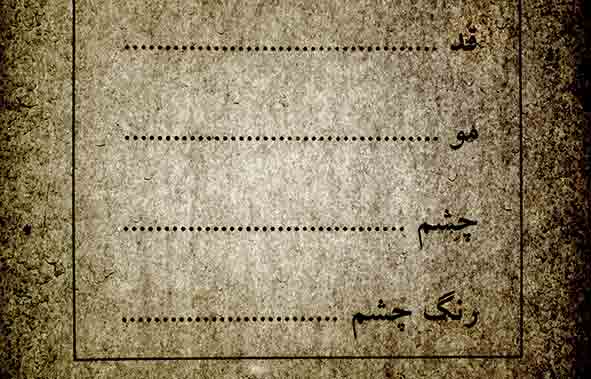
The copy is also an
identity document. Yet it is an identity whose defining fields have been
emptied and replaced only by rows of dots. There are no numbers to tell us the
person's height, no words to describe the color of their eyes or hair. Even if
those numbers and words were present, they still would not reveal the
individual; they would merely conjure up a generic type of human being. We know
well that such categories have served—or once served—primarily the purposes of
officials seeking to classify criminals.
In the absence of this
information, all that remains is a speck of light at the center encircled by
black grains. These grains remind me of the silver grains from which
photographs were once made. But these grains construct nothing. They no longer
seem like grains at all; they have become masses, stains—an encroaching
darkness that devours both light and words.
In this act of copying,
in the absence of numbers and words and in the presence of dots, it seems that
we are all criminals.