
Text
Mehran MohajerNarcissism
When I look at the
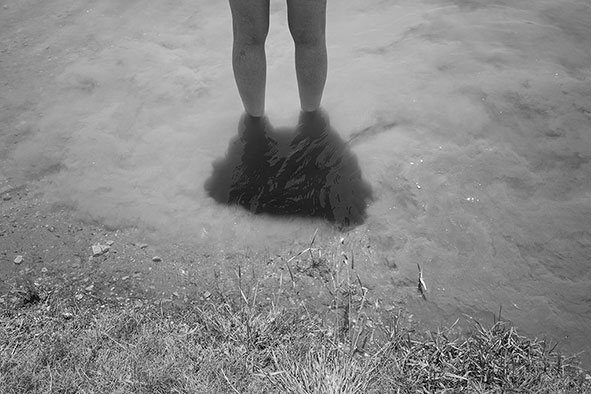
photograph, many things occupy my mind. The photograph seems to be about
photography. It seems to be about reflection. It speaks of a person looking at
their own image in a photograph. And it speaks of the photographer looking at
another. It is as though a child or a young girl is gazing at her own image in
the water. And as though the photographer is watching this act of looking. The
photograph reminds us of the myth of Narcissus, who became enamored of his own
image in the water and gazed at it for so long that he died. Or perhaps the
photograph has introduced a third person into the scene and wishes to say that
the photographer has been a witness to this act of looking. The photograph’s
incompleteness and fragmentation place before me so many “perhapses” and “as
ifs.”
It is as though the
photograph wanted to reveal something—or several things—to us, or perhaps
wanted to conceal certain things.
We see two standing
legs, as though they have paused, and we do not know whose head and body are
supported by these two legs. And we see a body in the water, a tangled mass,
headless and legless; the soft gray of the water and the streaked gray of the
meadow, both incomplete and fragmentary, one more so than the other.
The photograph evades
taking shape. Neither the quality of narcissism fully takes form nor does the
photographer completely finish the image of their gaze. And our continual
pleasure in looking, too, remains unfinished.