
Text
Pouya KarimThe Absence of the Face
The face is the fundamental site of contact and connection. It encompasses
two eyes (the windows of the soul and awareness) and a mouth (the
semi-transparent window of desire, decision, and emotion). The face is a mirror
that conveys the essence of the self (identity), a spectrum of emotions and
insights, revealing the inner world to the outer through our eyes. The face is
not merely a part of the body but in fact it houses the primary elements of
communication: sight and speech. The face and the hand (touch and tactility)
form the connection between us to the “other” and to the outside world. Much of
what we understand and learn about the "other" is mediated by the
expression of the face. For instance a child sees and hears before learning
language, and the adults interpret each other’s facial movements and
expressions. Yet sensory perceptions remain vague and obscure without language.
That is why the artist strives to give form to what is unsayable and invisible.
A valuable work of art gives expression to the ineffable, enriching experiences
that lie beyond daily life.
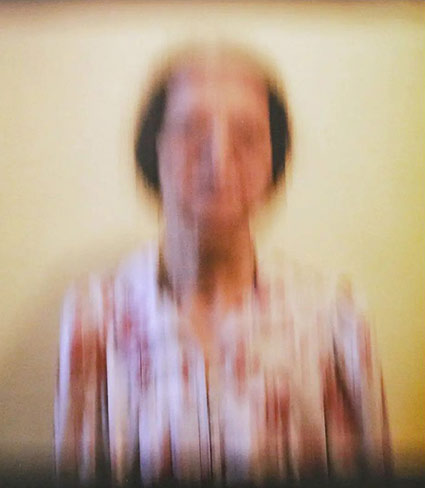
On the first page of The Book of Forgetting, a photo-book by
Farshid Azarang, we are faced with a full-frontal, blurred, and indistinct
portrait of a person, governed by a logic of absence, the absence of
the face. Through the temporality inherent in the photographic
medium, the artist removes the face from the portrait’s subject, creating an
image that on the one hand renders the mimetic language of portraiture and
photography mute and stammering and on the other decenters the identity and the
subject’s desire for immortality, granting instead centrality to the role of
art and the artist’s desire. In doing so, it moves beyond existing reality
toward an alternative, non-representational one, stripping the portrait of all
conventional functions and imbuing it with an aesthetic role. Thus, the removal
of the face from the subject highlights the tension between dualities: seeing
and not seeing, inside and outside, self (individual) and other (society),
image and reality, and—as Roland Barthes would say—"recognizing
and finding"