
Text
Pouya KarimOn the Road
“What we see in the mind is as real to us as what we see with our eyes.” –
Wallace Stevens
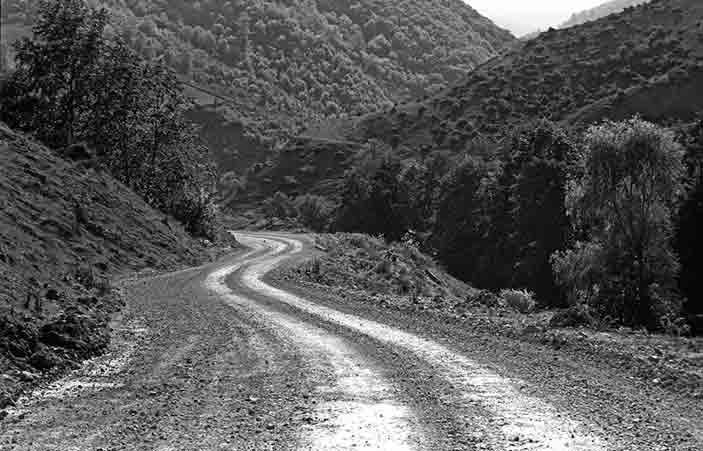
I have been staring the whole time at the bright white of the empty road as
if I am looking into the gray days of my own life. Like you I sometimes forget
that life is a passage that no miracle is coming on the road and that I must
walk this long and winding path alone. The horizon on the road is invisible and
there is no one present to answer my confusion and wandering.
Touraj Hamidian reveals the truth of the intersection between nature and
civilization in the in-between space of creation and observation and also
creates a formal and aesthetic relationship between the natural and the
constructed elements. The silence of the photograph on one hand reflects the
visually pleasing, non-geometric, and abstract forms, and on the other
expresses the incompatible and violent relationship of the alienated human with
the earth around him.
The relationship between the camera and the road is a historical connection
that is dialectically represented in the picture before us. On one side the
road opens as a landscape before the photographer’s eyes and on the other the
road like a home that embraces him becomes a boundless and timeless vista
revealing diverse possibilities for seeing and being in this world.
Furthermore, literature and music have played a significant role in opening
the language of the road shaping the human desire to seek meaning into form.
For example the coexistence of works by artists such as Robert Frank (the photograph
series The Americans (1958)), Jack Kerouac (the novel On the Road
(1957)), and Tom Waits (the song On the Road or The Houses That
Never Were My Home) form a meaningful trilogy that can represent the realm
of the human always on the road and the language of the road experience.