
Text
Ghazaleh HedayatThe Paper Crown and Photograph
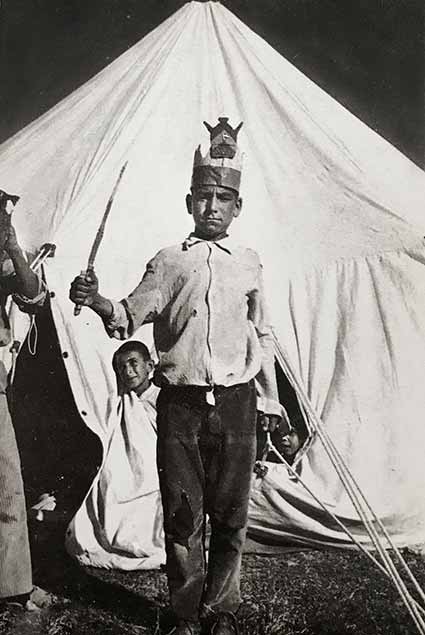
A small, ragged, sullen, frowning, sunburnt little king stands in the middle
of the image. He is pointing his sword toward his paper crown. What does that
number 3 or 4 above his crown signify? Perhaps it is his favorite number, or
maybe it’s the identification number of this small or big man in the classroom
inside this village tent. Kaveh Golestan showed us the brilliant collection Knowledge
Is Power from the years 1972 to 1975. He traveled to various parts of Iran,
such as Alamut in Qazvin, the desert villages of Kashan, and the plains around
Isfahan, to see and show us how these children saw and how they learned—to make
us aware of the state of education and the condition of schools. But this
brilliant picture is about the little king. The king who is right at the center
of the image and our gaze, with the school tent or his home behind him—over
whom does he rule? Who is this authoritative look directed at? It seems unaware
that another mischievous boy is playfully putting something on his head. The
two children behind do not see the main king; their gaze is toward the other
boy who is almost out of the frame, and no one sees him either.
Every time I see this picture, I cringe at the torn clothes, the worn shoes,
the tent, and those innocent faces. But my discomfort, I think, comes from
something far deeper and more compressed. It’s as if the whole photograph is
paper that crushes me, that boy, that crown, and that house altogether.