
Text
Pouya KarimUnderstanding an Ending
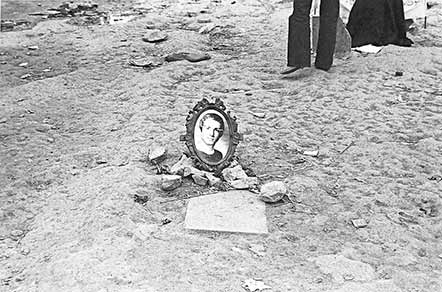
Some photographs are so pure and genuine that one must approach them without preamble so their clarity is not diminished. Rana Javadi has observed and documented a scene from the everyday life of people during the days of the revolution in a cemetery. The photographer places us before an image that has flaws, breaks, and deficiencies scattered throughout. Sometimes in the heart of life’s scenes the mundane reveals the depth of life right before our eyes. The collage-like, flat, and gray photograph expresses a disordered situation, buried in a haze of suffering, loss and frustration, and with a single glance one can perceive something deep within it—something that stirs our anxiety.
Is this perception truly influenced by the photographer’s simple and straightforward look or by a reluctance toward any kind of visual rhetoric? Or is it due to the subject: the broken frame, the nameless gravestone, the fragmented bodies, the words behind the curtain and the scattered trash on the barren ground? What exactly is it? Or perhaps it is nothing and only “emptiness.” I have never felt that I fully understand an image because an image is a static signifier and has no time. Looking at the present picture and writing about it brings forth various times that transform the photograph’s static and retrospective time into a time of “suspension.”