
Text
Ghazaleh HedayatThe Volume of Shadow
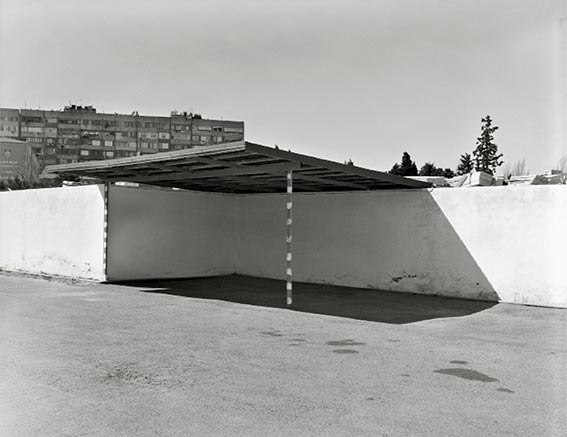
No matter how much I thought about it, I couldn’t understand what exactly
made this photograph catch my eye. Each time I paused, I couldn’t move past it.
Is it because it’s taken in Baku, Azerbaijan? Because the place feels familiar?
Because it represents time through such a shadow? Because it resonates with new
topographics? None of these seem to be enough for me to be so absorbed in
viewing — among the hundreds of pictures in this book, which is a dialogue
between a contemporary photographer and a photographer from over a hundred
years ago*. But still, I find myself entranced. What exactly am I looking at,
though? I don’t know. There are many pictures in this Dialogue that I long
and look for long periods, but with them, it’s as if I know where to anchor
myself. Here, I try to “read” the image. In this grayscale photograph, the
place where the car should be is an empty cube — it has given way to the
shadow. The shadow appears framed. It's as if that ceiling has become the
ceiling of the shadow.
The photograph doesn’t let me in. It doesn’t allow me to truly see it. The
photographer knew exactly where to stand so that I wouldn’t be able to
penetrate those shadowy walls from any angle. The shadow is a trapezoidal
surface that slides across the picture and creates an empty volume, pulling me
inward. I constantly try to tilt my head left or right, hoping to find a way
in, but that narrow striped column in the center holds me in place, keeps me
right in the middle, pushing me back toward the surface of the photograph. Each
time I look at this image, I wrestle with myself, but I can’t find a way into
the photograph. Looking is all I can do.
*.In the book Dialogue, Khosrow Peyghami
re-photographs the Silk Road route that Paul Nadar had photographed before.