
Text
Shahriar TavakoliI prefer Yahya Dehghanpour’s "single" photographs more than those
created through montage, collage, and similar techniques. In my view, the
familiar signs and elements in Dehghanpour’s imagery—which have gradually and
organically taken shape over the years, based on his own inner impulses and
momentary passions—are more vividly present in his standalone photographs than
in the orderly, disciplined execution of his constructed, arranged works.
Dehghanpour has always sought (and still does) not only to preserve traces
of Iranian culture within the formal experimentation of his photography, but
also to create a continuous dialogue between the verbal world of literature and
the visual realm of photography. His approach to various photographic styles
and the wide range of subjects he has worked with over the course of his
fifty-year career speaks not so much to a formalist experimentation with the "language
of photography", but rather to a deep concern with discovering new and ineffable
meanings.
Yahya Dehghanpour’s photographic world is weightless and light; full of
layered meanings and references, playful and delicate in its presentation of
resemblances and equivalencies—qualities that are fluidly rooted in our poetic
and literary tradition.
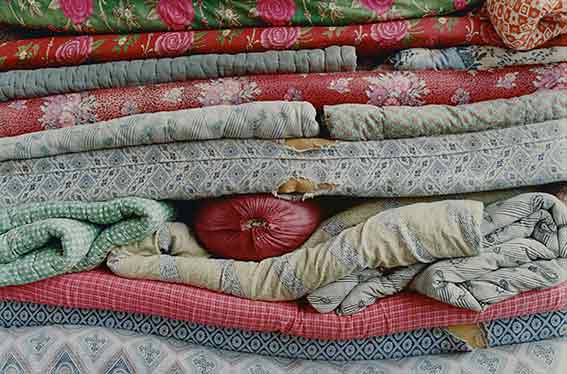
In this simple and direct photograph too, the "fragmentation" and
the tendency to flatten perspective—one of the structural foundations of many
of his images—make themselves known. Despite the absence of people, the photograph
feels lively and energetic, overflowing with recognizable features of
Dehghanpour’s visual universe: formalist precision, visual ambiguity, hidden
eroticism, overt humor, and the embodiment of an Iranian emotional atmosphere
that flows naturally from his own thought and artistic language.
The photograph of the beds—with its colorful world and its layered, stacked
surfaces; with its dense, tangled patterns and hues—resembles a beautiful,
eye-catching old patchwork quilt. It also serves as an apt metaphor for the
multifaceted, dispersed, and delightfully unfocused world of his spoken
thoughts and associations.
* This text was previously published on the website akasse.com with slight differences.