
Text
Ghazaleh HedayatA Celebration of the Gaze
The brilliant photographs from Hengameh
Golestan’s Wedding series have either remained unseen or rarely
viewed. And if today we glance at them, it’s likely thanks to the growing
popularity of casual, documentary-style photography in the West — and now in
Iran. I believe she is perhaps the only photographer whose images have so
effortlessly emerged from the tradition of family photo albums. Many of her
photographs have sharp, bold cuts — the edges of the frame either push us out
or pull us inward. The camera seems to be everywhere, as if it’s become one of
the people in the scene. One of those very close, intimate ones.
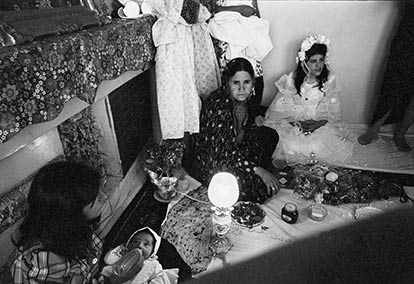
This photograph is of today, of yesterday, and of
tomorrow. The bride in this picture, looking out to the right side of the
frame, seems to have become the photographer’s subject of the present moment.
The mother of today — or perhaps the bride of yesterday — also looks outward
from the center of the image. Or perhaps she stares, not really seeing. Down in
the bottom left, another mother has her head turned toward us, but her gaze is
invisible — as if she, too, is staring outside the frame, to the right. And the
baby, at the very bottom of the image, is staring at the mother of today. The
baby's gaze pulls me toward the mother, into the image. But this time, I see
the mother’s gaze differently. I imagine her eyes fixed to the ground, lost in
her own thoughts. Now I notice the sangak bread, the lamp, the
flowerpot, the herbs, the cheese, the dish of confection — and the scattered
ones on the ground — and the tablecloth, half in shadow and half in light. I
see the bridal bouquet wrapped in tulle and the small gift boxes resting on it.
I see someone’s feet in the left corner, and the chadors of two others tucked
under their arms in the middle of the image. And again, the bright lamp at the
center.
Now, it’s me staring at the lamp — trying to
withdraw a bit from the noise of the people, the gazes, and the objects. To
distance myself, and to look at these women’s today, yesterday, and tomorrow—
and at the woman photographer who saw those women.